RHYMES WITH TRUCK

Tuesday, April 2, 2019

Cloud Museum

Old's Cool
The Cloud Museum in the fertile basin of the Colorado River, north of Yuma.
____ Jonny Cloud is more than willing to chat about anything and everything in his museum. Five dollars gets you past the pack of border collies and into a compound that has the largest collection of Ford Model T and Model A vehicles in the World. Not quite all the colours in all the sizes, but very nearly. There are tractors, trucks and a whole host of other antique stuff that will occupy well over two hours as you wander in and out of various buildings.

The Cloud Museum is well sign-posted and just before the Imperial Date Gardens in the village of Bard.

Impressive line-up of Ford TT flatbeds.

The restored vehicles are kept under-cover.

Nice Model A pick-up truck; up on blocks to save the tyres from flat-spotting.

The out-side line-up of Ford Model A; preservation is helped by the dry Arizona climate.
 
Fuel tanker that did local deliveries in the area.


Desert Taxi.

Bits of this and bits of that; put together to make a fun-looking buggy.

Ford Model A Pick-up Truck

Ford TT House-car; fore-runner of today's motor-homes.

Thursday, March 14, 2019

Imperial Dam, California.


____ South from Quartzsite on Highway 95 to the Big Guns of the Yuma Proving Grounds, home to the US Army and their base for testing all things military. It was here that they refined the floating pontoon bridges on the Colorado River that were used in World War Two and we head to the same place; crossing the river into California and camping at the Imperial Dam. Another BLM area and for $180 you can stay up to seven months with amenities to make life comfortable. Potable water, a waste water dump, pit toilets and trash bins are all on-site; hot showers for a dollar are one mile along the road.

____ It is a vast tract of desert scrubland; mainly flat with a rocky surface and crossed by dirt tracks, all with names. We settle in at Gravel Pit West, a sheltered spot within an easy walk to the pit-toilets and with two Quebecois neighbours. Maybe 300 RVs on the site but it is difficult to count as they spread themselves out; some seem to need solitude, some seem to like to be in a community. I like to have neighbours but not too close, just close enough to keep an eye on your stuff when you are away from the motor home and it seems a lot of people sit outside all day watching the World go by, so Imperial Dam does give you a sense of safety.

____ We decided to stay long-term at Imperial Dam, mainly to cut costs. Less fuel for the truck and cheap rent; the only difficult bit being the lack of a neighbourhood grocery store. We stocked up in Yuma and lasted eight days before needing to make the 40 mile round-trip into town again. Oranges and grapefruit were available at road-side vendors; $2.00 a net and the nearby Imperial Date Gardens had a whole host of edible goodies. It was a six-teen mile bicycle ride to fetch a variety of date related trail mixes or a date and nut cake with the date-shake being the high-light of the day. Cycling out in various directions became our daily exercise; riding up to 40 miles to the rhythm of America’s Horse With No Name, it felt good to out of the rain.

____ Life at Imperial Dam settled into a slow-paced routine; the morning coffee followed by breakfast, a trip to the dump and the ensuing socializing at the taps, drains and bins. A little bit of light maintenance on the truck or odd-jobs in the living quarters before a light lunch. The afternoon bike ride and recuperation in the zero-gravity chairs with a nice cup of tea. The sun was getting warmer every day and stayed up longer but evening came soon enough and after dinner we became star-gazers. Snuggled-up in a sleeping bag, lying back in the zero-gravities, rum and coke in hand, watching the satellites in orbit and picking out the constellations as airplanes headed to and from San Diego.

____ There were occasional glimpses of the wild donkeys that live in the desert. Next door neighbor caught a rattlesnake just outside his fifth-wheel and relocated it further into the wilderness. But the only event of note came one Sunday evening just as it was getting dark. There was a bang on the outside of the truck; it sounded like someone had hit it. I went out to find Gilles, the Quebecker to our right, lying on the ground beside the Mack. My first thought was that he had fell and dislocated his shoulder as I tried to get him to his feet; but his whole left side had gone limp; it was a stroke. Cheryl raced to tell the other Quebeckers and we managed to get Gilles into a chair as Cheryl called 911. His speech was slurred and the left corner of Gilles’ mouth drooped in the way it always does with stroke victims.

____ The emergency volunteers of the BLM came out and set-up a guided route for the paramedics to reach our campsite. First the Imperial Valley Fire Rescue and then the Winterhaven Emergency Ambulance. It was an hour later that the Medivac helicopter flew in and took Gilles to hospital; first Yuma and then onto Phoenix, Arizona. The Mack got a thorough sand-blasting as the chopper came down within 30 feet of our campsite. The other Quebeckers went to Phoenix to check on Gilles but the news was not good and he was air-lifted back to Montreal for, hopefully, a full recovery. A very sobering occurrence; for the man is only 61 years old and one of the youngest of the whole Imperial Dam community.

The view of Squaw Lake from the top of Imperial Dam.

Wild desert donkeys seem very healthy.

The hummingbird feeder hangs from the crane at the rear of the truck and the little birds are a joy to watch.

Seven desert donkeys on a field of rocks.

The very smart Peterbilt motorhome belongs to Les from Ontario and we had some great chats about his career as a recovery truck driver on the 401 in Toronto.


Wednesday, March 13, 2019

Quartzsite, Arizona.


Gonzaga Bay to Quartzsite.


____ From San Felipe, we elected to cross back into the US at the San Luis de Rio Colorado border; hoping to avoid the busier customs-post at Mexicali. But San Luis was busy too; a long, three-lane line-up running alongside the 12 foot high steel fence that forms the border where President Trump wants to build his wall. A three thousand strong caravan of Honduran immigrants had recently arrived in the area hoping to gain access to the United States and many were living under tarpaulins strung up against the fence as they waited for a chance to cross. The traffic moved far quicker than the pedestrian line; there was no commercial truck traffic at this border and it was centre lane for RVs. About two hours to get through with a new I94 Visa Waiver giving me another 90 days in the US.

____ A night just south of Yuma, at the Cocopah Casino RV parking after a trip round Walmart. Four dollars a night for a concrete pad among some very expensive motor-coaches before heading to Mittry Lake and a rendezvous with Gail and Milo. Mittry is BLM land and free for ten days in a calendar year. A palm tree oasis set at the edge of the desert where the Colorado River forms the state-line between Arizona and California. Just a couple of days stay before heading up US Highway 95 to Quartzsite but looking forward to another visit in the not too distant future.

____ Quartzsite is a town of 3000 people that swells to over 250,000 in the last week of January as it becomes the Mecca for RVers from all over North America. Such an influx would cause problems for almost any small town but Quartzsite is surrounded by flat desert and motorhomes, travel trailers, 5th wheelers and every imaginable kind of RV just spread themselves about on the BLM land. We choose the Hi Jolly area to the north of town, no services for camping but no charge either. The Big Tent is the big attraction, we cycled down to see the show every day. A lot of stuff is RV related; but as one regular old-timer said, “It ain’t what it used to be and is becoming more like the shopping channel.” Most interesting bit for me was wandering in and out of all the vehicles on display; the electrical circuitry in those things is so sophisticated these days. Most 45 foot motor-coaches have four flat-screen televisions but are set-up to sleep two persons.

____ Although the RV trade show is a big event, there is also a big social side to the Quartzsite gathering. Owner’s clubs for different RV marques hold annual reunions. Tiffin motor coaches had all their wagons in a circle at La Posa and Roadtrek campervans held their get-together at Hi Jolly. Rocks are another Quartzsite attraction as the town name might suggest; plenty of mineral and rock shops. Antique bric-a-brac market stalls fill in the gaps between the food trucks while side-by-side atvs and wide wheel jeeps park just about everywhere.

The queue for the border at San Luis de Rio Colorado. Under the blue tarps are families waiting for a chance to enter the USA.

Hilltop destination beside Mittry Lake. Milo let me drive his Suzuki Vitara to the top; forgetting to lock the free-wheel hubs and having me do it in two-wheel drive.

The view across the Colorado River from Arizona to California.

The BLM area called Hi Jolly. Flat desert covered with hundreds of RVs.

The Ghost; one of the few Class 8 Motorhome- trucks at the Quartzsite Show.

Old Peterbilt was the transport for the nearby antique dealer.

Not just RV stuff on sale in Quartzsite. Cattle skulls and hides too.


Tuesday, March 12, 2019

Gonzaga Bay, Baja California.

Scenic look-out on the road to Gonzaga Bay.


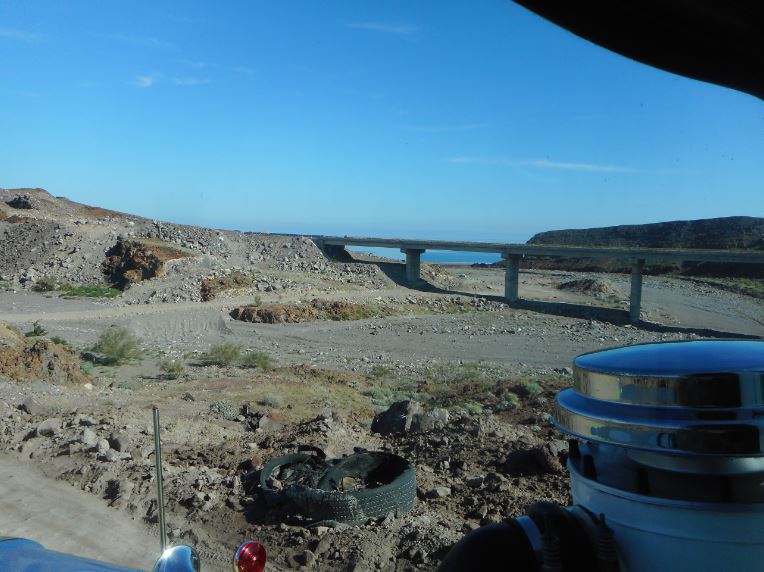
The new bridge still stands but the road at the end of it had washed away.

Waiting for two local trucks to come through one of the narrow detour tracks at the wash-outs.

Lots of repairs needed on the two year old road.

The calm water at Gonzaga Bay.
Parked between the huts on the beach at Gonzaga Bay.

The row of out-houses behind every campsite is convenient but not classy.
____ The Highway 5 South of San Felipe came with many warning tales; road construction and a tropical storm in September 2018 had made for difficult conditions. Pot-holes and dipped sections where water sometimes crosses made for slow going on the first section but that seemed super-sonic when we came to the road-works. Fifteen miles of wash-board on the temporary dirt track that ran alongside a yet-to-completed two-lane highway. All the way to Puertocilitos, where the new highway to Gonzaga Bay had been finished for a couple of years.  But it was here that the Great Storm of 2018 had highlighted the mis-calculations of the road engineers. The water volume during the flash-flooding had been so great that the bridges had become dams and the roadway onto the bridges had suffered catastrophic erosion. Nine bridges on the fifty mile stretch were still intact but un-crossable due the road being washed away at each end. Rough dirt tracks had been bull-dozed down onto the now dried-up river beds; some were easy detours, some were steep with a loose surface of rocks and ever-increasing pot-holes. The large diameter tyres and the heavy weight of the Mack helped us make it through with barely any wheel-spin.

____ At Gonzaga Bay, we chose the Rancho Grande Camping and RV Park. They have a small store and snack-bar on the Highway 5, opposite the Pemex fuel station. Camping was on the beach; down a track that ran alongside the local air-strip. We set-up camp at Palapa 7 with a retired fire-fighter and his wife at Palapa 5, they were from Squamish, BC. They were travelling in a pick-up truck with de-mountable camper in the bed; this seemed to be the favorite type of vehicle along this route; which made sense as a 4x4 was the most practical and there was more dirt road to come for those venturing further south over the pass. We booked-in for five nights, a quiet, scenic sandy beach with the calmest waters we had encountered on the Sea of Cortez.

____ The nights were now warmer with no discomfort for early-risers, we brewed the coffee with doors open; no longer needing the stove to take the chill out of the morning air. Beach-combing was our exercise but mostly we relaxed watching the coming and going of the local fishermen as they launched their small open boats off the beach to the south of our campsite. To the north was Alponsina’s Resort, a line of beach-front properties culminating in a two-story hotel at the far end of a sand-spit that ran out to an island in the bay. The place had a couple of long-term residents who both had inflatable dinghies for fishing; but most of our fellow campers just stayed for the one night while heading either north or south on what is the quieter alternative road in this part of Baja California. Lots of pick-up truck campers, a few travel-trailers, several adventure motor-cycles with their large alumimium box-like panniers and two cycle-tourers from Switzerland. A nice young couple, touring Mexico and Central America; they put their tent in the palapa next to ours and we gave them our lawn chairs to relax in.

____ It’s easy to lose track of time as the days blur together such is the relaxed atmosphere of beach life but I did wash the truck and do the second grease job of the trip. We bought some shrimp and fish locally but after five days our supplies dwindled down to nothing. Cheryl’s hazelnut flavored coffee creamer being the most critical item. We said goodbye to our new friends on the bay, packed everything securely in the truck and made our way back along the torturous road to San Felipe. Electing to have another couple a nights at Pete’s Camp, while checking out more of the town of San Felipe itself.

San Felipe, Baja California.

The Desert Road.

At Pete's Camp. San Felipe.

Dawn beside the Sea of Cortez, Baja California.

Digging in the sand at low-tide for the hot springs just south of San Felipe.

The pool at Reuben's Camp.

Deserted and derelict RV park south of San Felipe.


____ From Puerto Penasco we took Highway 30 along the coast where the Gran Desierto joined the Sea of Cortez and sand dunes stretched across the road. Heading west to cross the Colorado River on Highway 4 between Coaluila and Ledon; although it was easy to mistake the Grand Canyon’s water source for an average size irrigation canal, such is the volume of water extraction in the area. It was here that we encountered our first military checkpoint; conscripts of the Mexican army needed a guided tour of the Mack and I muddled through with some half-forgotten Spanish. It was a long wait in line but a relaxed examination from a young bunch of guys just doing their job. The other aspect of driving in Mexico that revealed it’s self on the road to San Felipe was the “Road-Hump.” Definitely not to be ignored and taken at speed. These were plentiful; some official speed control devices and some local improvisations that were intended to attract trade to nearby enterprises along with home-made Stop-signs.

____ We turned on to Highway 5, south of Mexicali and headed for Pete’s camp on the northern outskirts of San Felipe. A good four-lane coast road on the opposite side of the gulf; running through desert country within view of the water. Pete’s is down a well sign-posted dusty track but has the air of a prosperous resort; not so much camping but more villas and holiday homes. Just a handful of RVs; lined-up with the palapas on the beach. The place has a restaurant/bar, good toilets and showers; overall very clean and tidy but once again we felt like it was out of season. During our two day stay, we had long walks on the beach and met Ross from British Columbia. The old guy reckoned he had a Mack motor-home too and pictures on his phone proved that two years ago he brought it down to Pete’s Camp. We had several long chats about old school trucking and I think he wished he had his 1955 LT Mack with him this year instead of his 45 foot diesel-pushing motor-coach.

____ From Pete’s Camp, we moved to the south of San Felipe and Rueben’s Camp; like chalk and cheese. From opulence to an RV park post-Zombie Apocalypse. Rueben’s had once been high-end camping and a huge capital investment but now was being re-claimed by the desert. Dereliction everywhere with the attraction of “Hot Springs” as the only plus point. Hot water bubbled through the sand at low-tide and with some digging, one could have one’s own hot-tub right on the beach. Due to rain, we just dug a foot-spa; stood around getting wet and put it down to experience. We did some fishing from the rocks but caught nothing and the two nights at Rueben’s wasn’t a good or bad experience just different. Rueben is a nice guy and I think I would have given twenty dollars even if he said the camping was free. Loaded-up with water and supplies, we headed South from San Felipe still searching for that special Baja California experience.

Saturday, January 12, 2019

Rocky Point And Into Mexico.


____ Destination Doha would be a bit of an ask for a first-timer to do on his maiden trip across the water and so would be a tour of Downtown Mexico City. Small steps first; Puerto Penasco aka Rocky Point. Just a short hop through the desert after a painless crossing at Lukeville. Mexican Customs wanted a look inside the living quarters and took some photographs of the truck, including the VIN plate on the inside of the driver’s door. It was less than 5 minutes to get through as we did not need to post a $200 bond for a Temporary Import Permit. A TIP is not needed for the top end of Sonora and the Baja California areas. The road to Puerto Penasco boasts that it is hassle-free for US plated Vehicles and there were no checkpoints.

____ Rocky Point is about as far from immersion in Mexican culture as it is possible to get. The ratio of spoken Spanish to spoken English is the same as most American towns that are in Mexico bordering states. Disappointing in some respects but reassuring in others; everything is geared to helping the southbound tourist have a relaxing and stress-free vacation. Even changing currency is not necessary; everything is priced in both Pesos and US Dollars. For me it diminished the sense of adventure but for Cheryl it was like One Great Step For Mankind. We decided to bite the bullet on the issue of free camping, choosing to stay at Concha Del Mar RV Park. Twelve dollars a night with water on-site, a dump station for waste water, a restroom block with hot-showers, 24 hour security, Wi-Fi available at the office but with no electrical hook-ups. It was dusty bit we were parked on the beach, on the front row, in fact, in the only row as there were less than a dozen units in the whole camp.

____ We found ourselves parked next to Karl and Kathy from Alberta; Karl originally from Lancashire. The gap between us was split when Greg arrived from Oregon; a teacher originally from Yorkshire. We immediately formed the camp’s British Sector that stayed intact into the New Year. The Brits just about out-numbered the Americans with everybody else being Canadian; mostly from British Columbia. Canada’s BC to Mexico’s BC; Baja California. We soon got to know everyone on-site which gave a good sense of safety and security; it also brought a wealth of tips and advice on what to do and where to go in Rocky Point as most were returning visitors. “Ley” was the best supermarket, fresh shrimp was best bought from the stalls at the port and the Malecon was the busy restaurant and souvenir shop area in the heart of the old town. Concha Del Mar was the nearest RV park to the port and town centre, affording a great view of all the shrimp boats leaving and entering the harbour. Pelicans were the other watchable event, squadrons of these large birds patrolled the surf and frequently had feeding-frenzies; dive-bombing the shoals of white-bait accompanied by hordes of gulls that milled around hoping for a free meal. Dolphins too, put in an appearance on a couple of occasions as the Sea of Cortez gave up it’s plentiful riches.

____ The days were spent taking long walks on the beach. The shoreline was a mixture of RV Parks and multi-storey apartment blocks, sadly with the ugly hulks of unfinished condominiums blotting the landscape. Remnants of the property crash of 2008 and reminiscent of Southern Spain and their boom and bust. The RV parks all had paved roads, concrete parking slabs, full hook-ups and prices to match; a lot of the beachfront spots were occupied by big A-class motor-coaches. It was good to see that some people had the guts to bring these expensive monsters in Mexico but I doubt if any went much further than the end of the Hassle-Free Highway from Lukeville. Most evenings, someone would have  camp-fire which most of the park would take their lawn chairs; early night-fall saw these finish by 8 o’clock when all the wood had been burnt. New Year’s Eve was no exception with the fire long gone and all campers back in their vehicles when the local fireworks announced the arrival of 2019.

Puerto Penasco, the nearest beach to those living in Arizona.

Parked on the front row at Concha Del Mar RV Park in Puerto Penasco, Sonora, Mexico.

Sunset on the last day of 2018.

One of the many shrimp boats working out of Puerto Penasco.

A pelican led feeding-frenzy just off the beach in front of the truck.
   

Onto Arizona


____ The cycle touring gang disbanded at Austin; some going onto Florida with Rick while some returned to Manitoba and it’s winter. The SAG wagon retraced its way back across Texas using Interstate 10; refueling at Pilot/Flying J Truck stops in Junction, Fort Stockton and Van Horn before finally entering New Mexico on the western side of El Paso. Just a 180 miles more of Interstate 10 and we were in Arizona. By-passing New Mexico’s sites of interest in a quest to reach Casa Grande before Christmas. Cheryl’s sister and her husband have a winter retreat between Tucson and Phoenix; we had an invitation to visit for the festivities. We parked in their yard, alongside their motorhome and the partying began.

____ Casa Grande was big enough to have a selection of places selling truck tyres and I took the opportunity to get some quotes for a new set of drives. The old ones were starting to “cup” badly to the extent that you could hear it when driving with the windows open. The tread was still legal but I feared that the tyres were well past their use-by date. It turned out that they were 18 years old and the TA at Casa Grande couldn’t give me anything for the old casings. They did, however, give me a good discount on four new Roadmaster 11R22.5 tyres. It was a big hit to take half way through the trip but it was something that I knew would soon have to done and it good to the peace of mind that you are unlikely to get a blow-out. Once again it was nice to go to a place that was enthusiastic about the Mack; I felt they did a lot of effort into doing the best possible job for the lowest possible price.

____ Christmas over, new tyres installed and it was time to say Goodbye to Milo and Gail as we headed south on the next part of our winter adventure; Mexico. Our holiday hosts has been across the border on many occasions, on motor-cycles and in motorhomes, so armed with a wealth of helpful instructions, we pointed the Mack at a hole in Trump’s Wall and wondered what they would make of it. A few guidelines for travelers in vehicles going into Mexico: get vehicle insurance on-line before you go, [ the Mack was $125 for 6 months.] Plan on how far you are going to travel into Mexico, [there is no need for a Temporary Import Permit if you just intend to visit the Baja California peninsula.] Also, fill up with fuel before you cross as it is cheaper in the US and make sure you cross early enough in the day so you can reach your first night’s destination before dark, [night-time driving not recommended in Mexico.]

____ We reached the Arizona town called “Why” in early afternoon, about an hour North of the Lukeville crossing. I felt an affinity with the people of Why having once lived in the Hertfordshire town of Ware; it doesn’t take itself too seriously, with a fuel station called “Why-Not.” We spent the night on some BLM land, just south of the town. Bureau of Land Management has vast tracts of desert under it’s control in the USA and allows free-camping on a lot of it. Maximum stay is 14 days and the usual rules about leaving no trace apply. The Gunsite Wash area near Why was a huge area of scrubland with about half-a-dozen RVs scattered around on a network of criss-crossing dusty tracks. Our nearest neighbours trekked over to investigate the Mack and say “Hi.” They were from Canada and on their way to Mexico.

Nearly a thousand miles for a Christmas dinner.

The Mack parked beside our host's Coachman Motorhome at their place in Casa Grande, Arizona. 

The badly cupped 18 year-old drive tyres on the Mack.


Mack The SAG Wagon


____ SAG stands for Support and Gear; a term used for the vehicle that shadows a group of touring cyclists from one destination to another. I have done plenty of self-supported cycle tours and this was my first experience of SAG Wagons; added to which, I was the driver of the support vehicle. Although not built with the SAG job in mind; the Mack turned out to be perfectly suited to the job which was more than could be said about me. A day of cycling would cover about 50 to 70 miles, the Mack would do that in about an hour and a half at most. This means there was a lot of sitting about and waiting; waiting at the lunch location, waiting at the afternoon tea location and waiting for the intrepid adventurers at the night halt. I would set-up a table with food and drink at a suitable picnic spot, rest area or lay-by and wait. Sometimes they were grateful for the service, sometimes they had gone into a restaurant along the way and didn’t need what I had prepared and sometimes they changed their route on a whim and didn’t come past their feeding station. You can imagine how annoying that could be.

____ The tour started at El Paso and was scheduled to arrive in Austin on Day 14; about 600 miles away. Day One was to Fort Hancock and the hospitality of the local community church, who let the group overnight on the premises. Due to constant rain on Day Two, this stop turned into two nights. After that it never rained again on the whole trip. The kindness and generosity of a local church featured again at Sanderson; other nights were a mixture of hotel, motel and rental cabins. Some, good quality. Some expensive. Some dire. Some cozy and some were “Warm Showers”, which is a network of touring cyclists who offer hospitality to fellow touring cyclists on a reciprocal basis. But every night, Cheryl and I stayed in the truck; parked somewhere close by.

____ The Bicycle Boot Camp at El Paso did the world of good to Cheryl’s stamina. Daily trips of up to 40 miles in the week before the tour let her keep-up with ease. The group consisted of some very capable riders but she was never dropped and often led the way. Main man on the trip was Rick; in fact it was called “Ride with Rick for Parkinsons.” Bicycle riding is reckoned to help off-set the effects of Parkinson ’s disease and Rick has been out and about on his bike for the last six months. I didn’t have much time to judge for myself if it is an effective way of dealing with the mental and physical  symptoms of the disease but it seemed to have advantages for his carers. Instead of wandering-off and needing constant watching; Rick rode on the front of his recumbent tandem, peddling away all day with a variety of helpers doing the riding on the back. I never asked him if he was happy with his situation but I know that if it was me who had Parkinson’s then I wouldn’t want to be taken around the country on a bike. Just lock me up and let me fade away. But Rick’s carers really cared and were a happy bunch often riding into the darkness as the early night-fall of December cut down the daylight riding time.

____ The route started out on flat desert terrain; following Interstate 10 eastwards. Fort Hancock, Van Horn and Kent before cutting through the Davis Mountains and visiting the MacDonald Observatory on route to Alpine and US Highway 90. The SAG Wagon was essential on the long stretches of service-less road; near-ghost towns and a dry un-forgiving climate but with a tail-wind and gradual descent, all the way to Del Rio. The first week of riding gave the crew the fitness that they needed for the second; traversing the Texas Hill Country through the towns of Uvalde, Leakey, Hunt and Fredericksburg  before Johnson City, the terminus of the tour for Cheryl and I as we returned westwards across Texas. All in all; an experience that was sometimes enjoyable and sometimes frustrating but most of the time it was watching the road for the appearance of eight cycle tourers.

The Southern Tier Cycle Tourers Route from El Paso to Austin in Texas.

From right to left. Jill, Rick, Cheryl, John, Paul, Kristina, Anders, Leigh-Anne. At the start in El Paso.

At the double overnight stay in Fort Hancock.

Floods were no problem for the Mack but a detour for the bikers.

Rock-climbing as I waited in a picnic area beside Interstate 10 at Sierra Blanca.

Low cloud at a lunch break rest area.

More picnic tables on US Highway 90 on the way to Sanderson.

C R England wreck that was being recovered by Mike, our host  and pastor at the church were we had stayed the previous night. The rig had run so far off the road that it took them four days to get the site cleared.

At Rudy's in Del Rio, diesel for the truck and brisket sandwich for me.

Replica Stonehenge and Easter Island statues at Hunt in the Texas Hill Country.

Nimitz Hotel, Fredericksburg. Birth place of Admiral Chester Nimitz, Commander of US Naval Forces in the Battle for the Pacific during World War Two. A Statue and Museum to a true hero and gentleman.